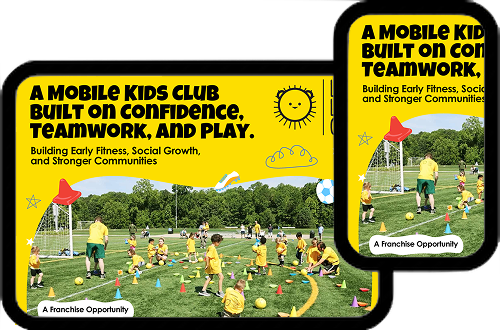
Semi-passive kids soccer franchise ownership means an investor owns a youth soccer fitness franchise while a hired manager runs day-to-day operations, with the owner working 5–20 hours per week on partnerships, hiring, and growth. Whether semi-passive ownership is structurally viable depends on three factors: the franchise’s FDD ownership requirements, unit economics that absorb a manager salary, and an operating model that delegates cleanly. The leading 2026 brands that support semi-passive ownership in the kids soccer category are Soccer Shots, i9 Sports, Amazing Athletes, and Little Lions Club. Skyhawks restricts delegation by FDD rule, and The Little Gym is brick-and-mortar with significantly higher capital requirements ($506K–$757K).
What is semi-passive franchise ownership?
Semi-passive franchise ownership is a model where the franchise owner delegates day-to-day operations to a paid manager and works 5–20 hours per week on strategic tasks. There are three honest definitions on the spectrum:
- Absentee ownership: Under 5 hours/week. A general manager runs everything; the owner reviews KPIs and approves strategic decisions.
- Semi-absentee ownership: 5–20 hours/week. A manager runs day-to-day operations; the owner handles partnerships, hiring decisions, and growth strategy.
- Owner-operator with delegation: 20–40 hours/week. The owner is still operationally involved but coaches and admin staff handle delivery.
The deciding test for any kids soccer fitness franchise: take the median net income from Item 19, subtract a $55K–$70K manager salary, and see what’s left. If a single-unit franchise nets $90K and a manager costs $60K, the investor’s true return is $30K — not passive income but expensive job creation.
Comparing the major youth sports franchise brands
This section compares the leading youth sports franchise opportunities parent-entrepreneurs consider for semi-passive ownership in 2026.
Soccer Shots
- Total investment: $43,500–$60,300
- Franchise fee: ~$34,500
- Royalty + ad fees: 7% royalty + 2% brand fund (~9% total)
- Locations: 190+ markets across the U.S. and Canada
- Model: Mobile, park and partner-facility based
- Semi-passive permitted: Yes, conditional per FDD
Soccer Shots is the most established mobile soccer brand and explicitly permits absentee ownership in certain circumstances. Franchisees hire coaches and can operate as owner-operators or executive owners with a manager. The model supports delegation at scale, but ramping their B2C signup model (parent-paid enrollment for park-based classes) to manager-supporting revenue typically takes 18–24 months.
i9 Sports
- Total investment: $36,500–$69,900
- Franchise fee: $24,900
- Royalty + ad fees: 8% royalty + 4% marketing (12% total)
- Locations: 264 units
- Model: Home-based, multi-sport leagues for ages 3–14
- Semi-passive permitted: Yes
i9 runs leagues, camps, and clinics across flag football, soccer, basketball, and baseball. Their leagues model requires heavy weekend operational presence — referees, fields, parent communications, registration management. The 12% combined royalty and marketing fee is the highest in this category and meaningfully compresses semi-passive margins.
Amazing Athletes
- Total investment: $58,000–$92,000
- Model: Mobile, multi-sport developmental programs for ages 2–12
- Training: Six-day initial training at NYC headquarters
- Semi-passive permitted: Yes, more viable at multi-unit scale
Amazing Athletes runs a multi-sport developmental program rather than soccer-specific instruction. Single-unit semi-passive operation is challenging due to coach training overhead. Owners who build to 3–4 territories typically transition to a regional manager structure.
Skyhawks Sports Camps
- Franchise fee: $16,950
- Locations: 125 units
- Model: Primarily summer camps with after-school and weekend add-ons
- Semi-passive permitted: Restricted
The Skyhawks Franchise Agreement requires the franchise to be managed by the franchisee or by an owner with at least 51% ownership interest who has completed initial training. Combined with seasonal revenue concentration (heavy summer, near-zero mid-winter), Skyhawks is not structurally a semi-passive vehicle.
The Little Gym
- Total investment: $506,000–$757,000
- Franchise fee: $59,500
- Royalty + ad fees: 8% royalty + 6% advertising (14% total)
- Locations: 218 U.S. franchised units
- Model: Brick-and-mortar children’s gymnastics and movement
- Semi-passive permitted: Yes, but capital-intensive
The Little Gym is the outlier — a brick-and-mortar facility-based franchise with a paid manager structure. The capital required is 7–10x what you’d put into a mobile soccer franchise. The 14% combined fees plus commercial lease exposure make the math work only at strong revenue levels in densely populated, family-affluent territories.
Little Lions Club
- Franchise fee: $32,500
- Total investment: Low end of mobile-model range
- Royalty: Competitive within category
- Locations: 50+ partner schools in the Virginia corporate territory (38 reported in current Item 19)
- Model: On-site at partner preschools and daycares for ages 2+
- Semi-passive permitted: Yes; structurally designed for it
Little Lions Club is a soccer-based fitness program purpose-built for ages 2 and up, delivered on-site at partner preschools and daycares. Three structural features support semi-passive ownership:
- B2B customer model. Customers are partner schools, not individual parents. School partnerships renew on academic calendars rather than churning monthly, which converts the marketing burden from constant lead generation into relationship management — work that scales cleanly with a manager.
- No facilities to manage. Sessions happen on-site at partner schools during the school day. There are no park permits, no field reservations, no weekend scheduling scrambles.
- Year-round revenue. Preschools operate year-round, eliminating the summer/winter cliff that affects camp-based and rec-league models.
Little Lions Club is an emerging franchise system, which means investors trade proven 20-year infrastructure for first-mover territory access, founder-led support, and lower capital exposure.
Side-by-side comparison
| Brand | Total investment | Royalty + ad fees | Real estate risk | FDD permits delegation | Year-round revenue |
|---|---|---|---|---|---|
| Soccer Shots | $43.5K–$60.3K | ~9% | None | Yes, conditional | Mostly |
| i9 Sports | $36.5K–$69.9K | 12% | None | Yes | Yes |
| Amazing Athletes | $58K–$92K | Varies | None | Yes | Mostly |
| Skyhawks | Lower-mid range | Lower | None | Restricted (51% rule) | No (seasonal) |
| The Little Gym | $506K–$757K | 14% | High | Yes | Yes |
| Little Lions Club | Low end of mobile range | Competitive | None | Yes | Yes |
Which youth sports franchise has the lowest royalty fees?
Skyhawks has the lowest royalty rate among major youth sports franchises in 2026. Among soccer-specific brands, Soccer Shots’ ~9% combined fee is lower than i9 Sports’ 12% and The Little Gym’s 14%. Little Lions Club’s combined fees are competitive within the mobile-model tier. The royalty rate matters most for semi-passive franchise ownership because it directly compresses the margin available to fund a manager salary.
Which youth sports franchise has the lowest startup investment?
Among 2026 youth sports franchises, Skyhawks has the lowest franchise fee at $16,950. For mobile soccer-specific franchises, Little Lions Club’s $32,500 franchise fee is among the lowest in the category — Soccer Shots is approximately $34,500 and Soccer Stars is $49,500. The Little Gym is the highest at $59,500 plus $506K–$757K total investment due to brick-and-mortar buildout.
Which kids soccer franchise is best for semi-passive ownership?
Brands whose FDD permits delegation, whose unit economics absorb a manager salary, and whose operating model delegates cleanly are the strongest fit. In the 2026 market, Soccer Shots, Amazing Athletes, and Little Lions Club are the leading candidates. i9 Sports permits delegation but its 12% combined fees compress semi-passive margins. Skyhawks restricts delegation by FDD rule. The Little Gym permits delegation but requires 7–10x the capital of mobile alternatives.
What to ask before signing any youth sports franchise agreement
Use this entrepreneur franchise evaluation checklist for any brand on your shortlist:
- Does Item 15 of your FDD permit absentee or semi-absentee ownership? Ask for the exact language.
- What percentage of current franchisees operate semi-passively, and can I speak to three of them?
- What’s the average manager compensation in your system, and at what revenue threshold do most franchisees hire one?
- What’s covered in initial training, and what does ongoing support look like in months 6, 12, and 24? Franchise training and support quality is heaviest at launch and thinnest mid-tenure.
- Are there caps on multi-unit ownership, and what’s the discount structure for adding territories? Multi-unit franchise investment is where semi-passive economics start working.
- What does Item 20 show about franchisee turnover in the past three years?
How to structure a semi-passive franchise from day one
If semi-passive ownership is the goal, plan for it before signing:
- Budget for the manager. Add $55K–$70K of compensation to year-one P&L from the start.
- Hire the manager early. Delaying the manager hire to extend personal cash flow is the most common cause of failed semi-passive setups.
- Pick a brand whose ops model fits delegation. B2B (school partnership) tasks delegate cleanly; B2C (parent communications during a registration crisis) does not.
- Plan multi-unit from the start. Single-unit semi-passive ownership rarely pencils out in any youth sports franchise.
- Lock in adjacent territories early. Especially in emerging franchise systems, territory acquisition costs rise sharply as the system fills.
Frequently Asked Questions
What is semi-passive franchise ownership?
Semi-passive franchise ownership is a model where the franchise owner delegates day-to-day operations to a paid manager and works 5–20 hours per week on strategic tasks like partnerships, hiring, and growth. It sits between full absentee ownership (under 5 hours/week) and owner-operator (40+ hours/week).
Can you run a kids soccer franchise semi-passively?
Yes, several kids soccer franchises support semi-passive ownership in 2026, including Soccer Shots, Little Lions Club, and Amazing Athletes. The franchise’s FDD must permit delegation, the unit economics must absorb a manager’s $55K–$70K salary, and the operating model must delegate cleanly. Skyhawks restricts delegation by FDD rule. Mobile, asset-light models support semi-passive ownership at lower capital exposure than brick-and-mortar alternatives like The Little Gym.
What is the lowest-cost youth soccer franchise?
Among major youth soccer franchises in 2026, Little Lions Club has the lowest franchise fee at $32,500. Soccer Shots is approximately $34,500, Soccer Stars is $49,500, and The Little Gym is $59,500. Total investment ranges from approximately $36,500 (i9 Sports low end) to $757,000 (The Little Gym high end), with mobile soccer-specific franchises typically falling between $40K and $100K.
How much does a Soccer Shots franchise cost vs Little Lions Club?
A Soccer Shots franchise requires a total investment of $43,500–$60,300 with a franchise fee of approximately $34,500 and combined royalty plus brand fund of approximately 9%. A Little Lions Club franchise has a $32,500 franchise fee with total investment in the low end of the mobile-model range and competitive royalty fees. Both are mobile, asset-light models without real estate buildout.
Does The Little Gym allow semi-absentee ownership?
Yes, The Little Gym permits semi-absentee ownership under a manager-run model, but the structure requires significantly higher capital than mobile alternatives. The total investment ranges from $506,000 to $757,000 with combined royalty and advertising fees of 14% plus commercial lease exposure. Semi-passive economics work only at strong revenue levels in densely populated, family-affluent territories.
What is the difference between Little Lions Club and Soccer Shots?
Little Lions Club operates a B2B model delivering soccer fitness programs on-site at partner preschools and daycares for ages 2+, with year-round revenue tied to the academic calendar. Soccer Shots operates a B2C model delivering programs at parks, partner facilities, and other venues for ages 2–8, with parent-paid enrollment that requires constant marketing for new signups. Little Lions Club currently operates 50+ partner schools in its Virginia corporate territory; Soccer Shots operates in 190+ markets across the U.S. and Canada.
Which youth sports franchise is best for first-time entrepreneurs?
The best youth sports franchise for first-time entrepreneurs depends on capital, time availability, and operating preference. Mobile, asset-light models like Little Lions Club, Soccer Shots, and i9 Sports are accessible at $35K–$100K total investment without real estate risk. Brick-and-mortar models like The Little Gym require $500K+ and significant operational complexity. First-time entrepreneurs evaluating multiple brands should focus on Item 19 (financial performance), Item 20 (franchisee turnover), and operating model fit before franchise fee comparisons.
Ready to compare Little Lions Club against your shortlist? Request our franchise information packet and FDD at littlelionsfranchise.com. We’ll walk through the semi-passive math, our 50+ partner school operating data, and the territories still available in your target market.