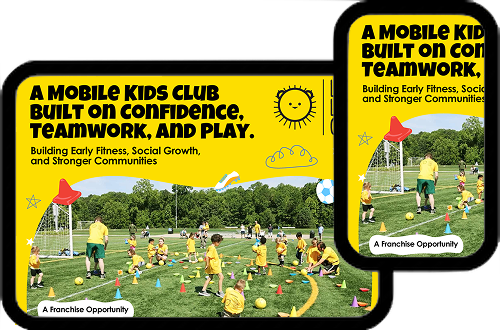
Mobile and on-site youth soccer franchises now outperform brick-and-mortar alternatives across every metric that matters to franchise investors — capital exposure, time to break-even, real estate risk, semi-passive viability, and downside protection in soft markets. The 2026 shift is structural, not cyclical. Rising commercial lease rates, tighter SBA underwriting, and changes in how families consume youth fitness have widened the gap between the two models. For investors evaluating youth soccer fitness franchise opportunities, the model decision now drives more of the long-term return than the brand decision.
This post walks through why the mobile model wins in 2026, which structural advantages compound over time, and how to evaluate the trade-offs honestly.
Quick Answer
Mobile and on-site youth soccer franchises outperform brick-and-mortar youth fitness franchises in 2026 because they require 7–10x less capital ($35K–$100K vs. $500K+), eliminate commercial lease risk, break even faster (typically 6–18 months vs. 18–36 months), and support semi-passive ownership at lower revenue thresholds. Mobile franchises like Soccer Shots, Amazing Athletes, and Little Lions Club operate without facility buildout, dedicated leases, or full-time facility staff. Brick-and-mortar models like The Little Gym carry $200K–$500K of construction risk above the franchise fee plus 5–10 year commercial lease commitments. The capital-light advantage compounds across multi-unit portfolios.
What is a mobile soccer franchise?
A mobile soccer franchise delivers programs at parks, partner schools, daycare facilities, or other third-party venues without operating a dedicated facility. The franchisee works from home, hires coaches who travel to session locations, and pays no commercial rent. Examples include Soccer Shots (parks and partner facilities), Amazing Athletes (mobile multi-sport), i9 Sports (home-based leagues at public fields), and Little Lions Club (on-site at preschools and daycares).
A brick-and-mortar youth fitness franchise operates a dedicated facility with a commercial lease, full buildout, and on-site staff. The Little Gym is the most established example in the youth fitness category, with 218 U.S. franchised units operating dedicated children’s gymnastics facilities.
The two models compete for the same parent-customer dollar but have fundamentally different cost structures, risk profiles, and operational requirements.
Why mobile soccer franchises win in 2026
1. Capital exposure is 7–10x lower
The single largest difference between the two models is capital at risk on day one.
| Model | Total investment range | Franchise fee | Real estate cost |
|---|---|---|---|
| Mobile soccer (Soccer Shots, Little Lions Club, Amazing Athletes) | $35K–$100K | $24,900–$49,500 | $0 |
| Home-based leagues (i9 Sports) | $36.5K–$69.9K | $24,900 | $0 |
| Brick-and-mortar youth fitness (The Little Gym) | $506K–$757K | $59,500 | $200K–$500K buildout + lease |
A first-time franchise investor can enter a mobile soccer franchise for under $100K in many cases. The same investor evaluating brick-and-mortar youth fitness needs $500K+ in capital, typically including a personally guaranteed commercial lease and SBA-backed buildout debt. The downside if a market underperforms is correspondingly larger.
2. Lease risk is eliminated
Commercial lease exposure is one of the most common causes of early-stage franchise failure. A 5–10 year lease commitment is signed before the business has proven itself in the market. If revenue underperforms, the franchisee carries fixed rent obligations regardless of unit performance. If the franchisee wants to exit, they remain personally guaranteed on the remaining lease term — often $200K–$500K of additional liability beyond the original investment.
Mobile models eliminate this risk entirely. Sessions happen at parks, partner schools, or facilities owned by third parties. There’s no lease to break, no buildout to abandon, and no fixed real estate cost compressing the P&L during slow seasons.
3. Break-even arrives faster
Mobile soccer franchises typically break even within 6–18 months. Brick-and-mortar youth fitness franchises require 18–36 months to break even, and that timeline assumes the facility hits projected enrollment.
The math is structural. A mobile franchise’s largest fixed cost is the owner’s time. A brick-and-mortar franchise’s largest fixed costs are rent, utilities, full-time staff, and equipment depreciation — all of which run regardless of revenue. The mobile model can scale revenue against a near-zero fixed cost base; the brick-and-mortar model needs to clear a much higher fixed-cost threshold before any operating profit appears.
4. Semi-passive ownership pencils out at lower revenue
Semi-passive franchise ownership requires unit economics that absorb a manager salary ($55K–$70K) and still leave the investor an acceptable return.
In a mobile model with low fixed costs and combined royalty/ad fees of 9–10%, a franchise can support a manager salary at significantly lower revenue than a brick-and-mortar model. The Little Gym’s 14% combined fees (8% royalty + 6% advertising) plus rent, utilities, and full-time facility staff push the manager-supporting revenue threshold dramatically higher.
For investors targeting semi-passive ownership from day one — which is the predominant goal among parent-entrepreneurs and busy professionals entering the franchise market — mobile models clear that bar at revenue levels brick-and-mortar models can’t approach.
5. The customer-experience gap has narrowed
The historical argument for brick-and-mortar youth fitness was that families wanted a dedicated, controlled, professionally outfitted facility. That argument has weakened in 2026 for two reasons.
First, consumer preference has shifted toward convenience. Programs delivered on-site at a child’s preschool or daycare during the school day eliminate the parent’s after-school transportation burden — a meaningful value driver for working families and a structural advantage of the on-site partner-school model.
Second, the perceived quality gap between facility-based and mobile programs has closed. Modern mobile soccer franchises bring branded equipment, structured curricula, and trained coaches to high-quality venues. Parents are increasingly indifferent to whether the program runs at a dedicated gym or at their child’s preschool — and many actively prefer the latter.
6. Multi-unit scaling is dramatically cheaper
For investors planning a portfolio strategy, the math diverges further at scale.
A mobile franchise investor adding territory #2 needs to hire a regional coach lead, expand marketing reach, and lock in territory rights — typically $30K–$60K of incremental investment. A brick-and-mortar investor adding facility #2 needs another $500K+ of capital, another commercial lease, another full buildout, and another full facility staff hire. Multi-unit franchise investment in mobile models compounds revenue and operational synergy across territories without compounding facility risk.
The cumulative capital exposure for a 3-unit mobile portfolio runs $150K–$300K. The cumulative capital exposure for a 3-unit brick-and-mortar portfolio runs $1.5M–$2.3M. That’s not a small difference — it’s a different category of investor altogether.
7. Resilience to economic softness is higher
Mobile franchises are structurally more resilient in soft markets because their fixed cost base is small. When enrollment dips 15% in a recession, a mobile franchise loses 15% of revenue against minimal fixed costs. A brick-and-mortar franchise loses 15% of revenue against rent, utilities, equipment loans, and full-time staff that don’t shrink with enrollment.
Youth fitness is generally recession-resistant, but no category is fully immune. Mobile models give investors meaningfully better downside protection if the macro environment softens or if a specific market underperforms expectations.
What brick-and-mortar still wins on
A balanced comparison requires acknowledging where brick-and-mortar youth fitness genuinely wins:
- Brand presence in a market. A dedicated facility with signage and visibility creates marketing benefit that mobile models replicate only through digital and partnership channels.
- Birthday parties and ancillary revenue. A facility can monetize evenings, weekends, and parties in ways mobile models can’t.
- Pricing power at high enrollment. A successful brick-and-mortar location at high utilization can outperform a mobile franchise on absolute revenue, though margin compression from fixed costs often closes the gap.
- Investor profile fit. Some investors are specifically looking for a brick-and-mortar play where a manager runs a defined facility. The model isn’t wrong — it’s a different fit.
The honest answer: brick-and-mortar youth fitness can outperform mobile in absolute revenue at high utilization, but the capital required, lease risk, time to break-even, and downside exposure make it a poor fit for first-time franchise investors and most parent-entrepreneurs.
How Little Lions Club fits the mobile-model thesis
Little Lions Club is purpose-built around the structural advantages of the mobile model and adds a specific innovation on top: on-site delivery at partner preschools and daycares for ages 2+.
The on-site partner-school approach captures the mobile model’s structural wins and adds three more:
- B2B revenue stability. School partnerships renew on academic calendars, replacing the constant B2C signup churn that affects park-based mobile programs.
- Convenience-driven parent demand. Programs run during the school day at the child’s existing preschool or daycare. No after-school transportation required.
- Year-round revenue. Preschools operate year-round, eliminating the seasonal cliff that affects rec-league and camp models.
Operating data: Little Lions Club currently runs 50+ partner schools in its Virginia corporate territory (38 reported at most recent Item 19 filing), with founder-led support directly from PJ Johnston and Chris Miller. The franchise fee is $32,500 — among the lowest in the youth soccer category — with no real estate, no buildout, and no commercial lease risk.
For investors evaluating kids soccer franchise opportunities specifically through the mobile-model lens, Little Lions Club represents the structural thesis taken to its logical endpoint: the lowest-capital entry, the most convenient customer experience, and the most stable revenue model in the category.
How to decide: mobile or brick-and-mortar?
A practical decision framework:
Choose mobile if you:
- Have $35K–$150K of investable capital
- Want to break even within 12–18 months
- Plan to operate semi-passively or build a multi-unit portfolio
- Want to minimize downside risk if a market underperforms
- Are entering franchising for the first time
Choose brick-and-mortar if you:
- Have $600K+ of investable capital and are comfortable with personal guarantees
- Have prior experience operating brick-and-mortar businesses
- Are targeting a specific high-density, family-affluent territory where utilization will be strong
- Want a single defined location rather than a distributed operation
- Are comfortable with 24–36 month break-even timelines
For most parent-entrepreneurs and first-time franchise investors evaluating youth sports franchise opportunities in 2026, the mobile model is the better fit by a wide margin.
Frequently Asked Questions
What is the difference between a mobile soccer franchise and a brick-and-mortar youth fitness franchise?
A mobile soccer franchise delivers programs at parks, partner schools, daycares, or other third-party venues without operating a dedicated facility, typically requiring $35K–$100K total investment. A brick-and-mortar youth fitness franchise operates a dedicated facility with a commercial lease and full buildout, typically requiring $500K+ total investment. Mobile models eliminate real estate risk, break even faster, and support semi-passive ownership at lower revenue thresholds.
How much does a mobile soccer franchise cost compared to brick-and-mortar?
Mobile soccer franchises in 2026 range from approximately $35,000 to $100,000 in total investment, with franchise fees between $24,900 and $49,500. Brick-and-mortar youth fitness franchises like The Little Gym range from $506,000 to $757,000 in total investment, with franchise fees of $59,500 plus $200K–$500K of buildout and a 5–10 year commercial lease commitment. The capital required is 7–10x higher for brick-and-mortar.
Which youth soccer franchises are mobile?
Mobile youth soccer and youth sports franchises in 2026 include Soccer Shots (parks and partner facilities), Amazing Athletes (mobile multi-sport), i9 Sports (home-based leagues at public fields), and Little Lions Club (on-site at preschools and daycares). All operate without dedicated facilities, commercial leases, or facility staff. Total investment ranges from approximately $35,000 to $100,000 depending on the brand.
Are mobile franchises better for first-time investors?
Yes, mobile franchises are generally better suited for first-time franchise investors because they require significantly less capital, eliminate commercial lease risk, break even faster, and support semi-passive ownership at lower revenue thresholds. Brick-and-mortar youth fitness franchises require $500K+ of capital, personal guarantees on commercial leases, and 24–36 month break-even timelines that demand prior business operating experience.
What is the break-even timeline for a mobile soccer franchise?
Mobile soccer franchises typically break even within 6–18 months, depending on the brand, territory, and operator effort. The faster timeline is structural — mobile models have minimal fixed costs (no rent, utilities, or facility staff), so revenue scales against a near-zero fixed cost base. Brick-and-mortar youth fitness franchises typically require 18–36 months to break even because they must first clear higher fixed-cost thresholds.
How does the mobile model affect semi-passive franchise ownership?
Mobile models support semi-passive franchise ownership at significantly lower revenue thresholds than brick-and-mortar models. A mobile franchise can absorb a $55K–$70K manager salary at lower gross revenue because the fixed cost base is small and combined royalty plus ad fees typically run 9–12%. Brick-and-mortar franchises with 14% combined fees plus rent, utilities, and full-time facility staff require dramatically higher revenue to support the same manager structure with acceptable investor returns.
What customer model works best for mobile youth soccer franchises?
Mobile youth soccer franchises operate on either B2C models (parent-paid signups for park-based programs, like Soccer Shots) or B2B models (school or facility partnership-paid programs, like Little Lions Club). B2B models offer more revenue stability through academic-calendar renewals, lower marketing burden, and cleaner delegation to a hired manager — making them especially well-suited for investors targeting semi-passive ownership.
Want to see how the mobile model performs in your specific market? Request the Little Lions Club franchise information packet and FDD at littlelionsfranchise.com. We’ll walk through the capital-light, on-site partner-school model with specifics — including the territories still available in your target market.