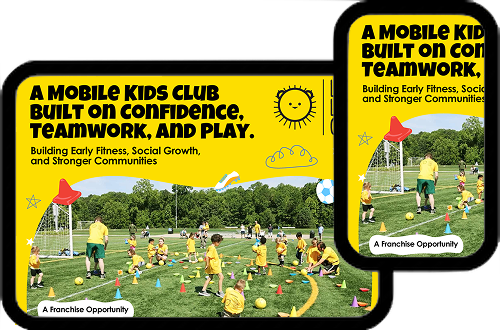
Mobile vs Facility-Based Kids Soccer Franchises in 2026: Which Model Costs Less and Generates More Revenue?
Mobile kids soccer franchises require 60-85% less startup capital than facility-based models, eliminating real estate deposits, buildout costs, and monthly rent expenses that can reach $15,000 per month. This fundamental cost difference shapes every aspect of franchise operations, from launch timelines to ongoing profitability potential.
The youth soccer franchise market offers two distinct paths for parent-entrepreneurs: mobile programs that travel to schools and community centers, or brick-and-mortar facilities with dedicated indoor space. Understanding the financial and operational trade-offs helps you choose the model that fits your family life and business goals.
What Are the Startup Cost Differences Between Mobile and Facility-Based Models?
Mobile kids soccer franchises typically require $31,000-$70,000 in total investment, while facility-based models demand $500,000-$1.5 million according to WagBar.
The cost gap stems from three major facility expenses that mobile operators avoid entirely:
- Real estate deposits and lease commitments: $150,000-$400,000 (WagBar)
- Buildout and renovations: $200,000-$600,000 (WagBar)
- Equipment and technology systems: $75,000-$200,000 (WagBar)
Mobile franchises eliminate these expenses by operating in existing community venues. Soccer Shots, a mobile model, requires $42,950-$54,300 in total startup costs according to Franchise Direct. Their 330 estimated franchise units demonstrate the scalability of asset-light operations.
| Franchise Model | Franchise Fee | Total Investment | Real Estate Required |
|---|---|---|---|
| Little Lions Club (Mobile) | $32,500 | $43,500-$55,700 | None |
| Soccer Shots (Mobile) | $29,500 | $31,742-$39,000 | None |
| Lil’ Kickers (Mobile) | $25,000 | $40,050-$64,490 | None |
| i9 Sports (Mobile) | $24,900 | $35,000-$69,900 | None |
| Kidokinetics (Mobile) | $60,000 | ~$103,000 | None |
| Facility-Based Average | Varies | $500,000-$1.5M | Required |
How Do Monthly Operating Expenses Compare Between Models?
Mobile soccer franchises avoid the $5,000-$15,000 monthly rent that facility-based operators pay, creating $60,000-$180,000 in annual savings according to WagBar research.
Facility-based operations carry fixed overhead regardless of enrollment numbers. Monthly rent, utilities, insurance, and maintenance create baseline expenses before serving a single child. Mobile operators pay venue fees only when programs run, typically $100-$500 per session depending on location.
Additional facility costs include:
- Property insurance and liability coverage
- Utilities and maintenance
- Security systems and cleaning services
- Property taxes or CAM charges
- Equipment storage and replacement
Mobile franchises operate from home offices and store equipment in vehicles or small storage units. This flexibility allows you to scale expenses with revenue growth rather than committing to fixed overhead from day one.
What Revenue Potential Differences Exist Between Mobile and Facility Models?
Facility-based franchises generate $800,000-$2 million in annual revenue compared to mobile models averaging $150,000-$250,000 per unit, according to WagBar industry analysis.
The revenue gap reflects different business models rather than profitability differences. Facility-based operations serve more children simultaneously through camps, birthday parties, and open play sessions. They capture revenue from multiple program types and extended hours.
Mobile franchises focus on recurring weekly programs with smaller class sizes. Little Lions Club generated $372,000 across 38 schools in 2025, averaging $9,809 per school location. This recurring revenue model provides predictable cash flow with lower operational complexity.
Revenue factors for each model:
Facility-Based Advantages:
- Higher capacity per session
- Multiple revenue streams (camps, parties, retail)
- Extended operating hours
- Year-round programming potential
Mobile Model Advantages:
- Multiple locations per day
- Lower customer acquisition costs
- Built-in marketing through school partnerships
- Recurring weekly revenue
Which Model Launches Faster and Requires Less Experience?
Mobile soccer franchises launch within 6-12 months compared to 18-36 months for facility-based operations, according to WagBar research on franchise development timelines. Little Lions Club is capable of launching in as little as 2-3 months.
The speed difference comes from eliminating real estate processes. Finding suitable locations, negotiating leases, obtaining permits, and completing buildouts extends facility-based launches significantly. Many franchisees underestimate these timelines and face delayed revenue starts.
Mobile operations begin generating revenue as soon as training completes and initial partnerships form. You can start with one or two school locations and expand gradually based on capacity and demand.
Experience requirements also differ:
Facility-Based Requirements:
- Retail or hospitality management experience preferred
- Staff hiring and management skills
- Commercial real estate knowledge helpful
- Higher net worth requirements
Mobile Model Requirements:
- Comfort working with young children
- Basic business and scheduling skills
- Reliable transportation
- Community networking ability
According to the International Franchise Association, there are approximately 806,000 franchise establishments in the United States, with mobile models representing a growing segment due to their accessibility for first-time business owners.
What Are the Key Operational Challenges for Each Model?
Mobile franchises face scheduling complexity and weather dependency, while facility-based operations manage higher staffing costs and fixed overhead pressure.
Mobile operators coordinate multiple locations, manage equipment transport, and adapt to venue changes. Rainy days can cancel outdoor programs, requiring makeup sessions and parent communication. Equipment setup and breakdown add time to each session.
Facility-based challenges include:
- Staff scheduling across multiple program types
- Facility maintenance and safety compliance
- Higher break-even requirements due to fixed costs
- Competition from other local facilities
- Seasonal enrollment fluctuations affecting high overhead
Mobile model challenges include:
- Weather-dependent programming
- Equipment transport and setup time
- Venue availability and scheduling conflicts
- Limited capacity per session
- Dependence on partner location relationships
How Do Customer Acquisition Strategies Differ Between Models?
Mobile franchises benefit from built-in marketing through school partnerships, while facility-based operators rely more heavily on community advertising and digital marketing campaigns.
Mobile programs operate within established childcare centers and preschools, accessing enrolled families directly. Parents already trust the venue, reducing the marketing effort needed to build credibility. School administrators often promote programs to families, creating warm referrals.
Facility-based operators must attract families to visit their location, requiring stronger marketing investments. They compete with other activities for family time and must establish their brand independently.
Customer acquisition approaches:
Mobile Model Advantages:
- Direct access to target families through schools
- Built-in venue credibility
- Convenient scheduling during school hours
- Lower marketing costs per enrollment
Facility-Based Advantages:
- Visible storefront location
- Multiple touchpoints with families
- Ability to host events and open houses
- Retail and merchandise opportunities
Which Model Better Fits Parent-Entrepreneur Lifestyles?
Mobile soccer franchises offer greater schedule flexibility and family integration, allowing parent-entrepreneurs to build programs around school pickup times and family commitments.
Many mobile franchise owners operate programs during morning preschool hours, leaving afternoons free for family time. You can adjust your schedule seasonally and take breaks during school holidays without paying facility overhead.
The franchise opportunity with Little Lions Club exemplifies this flexibility. Programs run 30-45 minutes per session, allowing multiple locations per day while maintaining work-life balance.
Facility-based operations require consistent presence during all operating hours. Evening and weekend programs are common, potentially conflicting with family time. Staff management becomes necessary as the business grows, adding complexity.
Consider these lifestyle factors:
Mobile Model Benefits:
- Flexible scheduling around family needs
- No evening or weekend requirements
- Ability to bring children to some programs
- Travel opportunities with portable business
Facility-Based Considerations:
- Fixed location requires consistent presence
- Evening and weekend programming common
- Staff management responsibilities
- Higher stress from fixed overhead obligations
What Should You Choose: Mobile or Facility-Based?
Choose mobile if you prioritize low startup costs, schedule flexibility, and gradual growth, or facility-based if you have substantial capital and want to maximize revenue potential in a single market.
Mobile models suit parent-entrepreneurs seeking business ownership without overwhelming their family commitments. The lower financial risk allows you to test entrepreneurship while maintaining other income sources if needed.
Facility-based franchises work better for experienced business operators with significant capital who want to create a substantial local presence. The higher revenue potential justifies the increased complexity and risk.
Key decision factors:
- Available capital: Mobile requires $31K-$70K vs $500K-$1.5M for facilities
- Risk tolerance: Mobile has lower fixed costs and easier exit options
- Time commitment: Mobile offers more flexibility for part-time operation
- Growth goals: Facilities have higher revenue ceilings but require more resources
- Market size: Dense populations may support facilities; suburban areas favor mobile
For detailed investment information and franchise comparisons, visit our franchise investment details page or explore our franchise resources section.
The youth soccer franchise market offers proven opportunities in both models. Your choice should align with your financial situation, lifestyle goals, and business experience level. Both paths can create rewarding businesses that serve children while generating sustainable income for your family.